Essex Regiment Museum and The Essex Yeomanry

Facilities
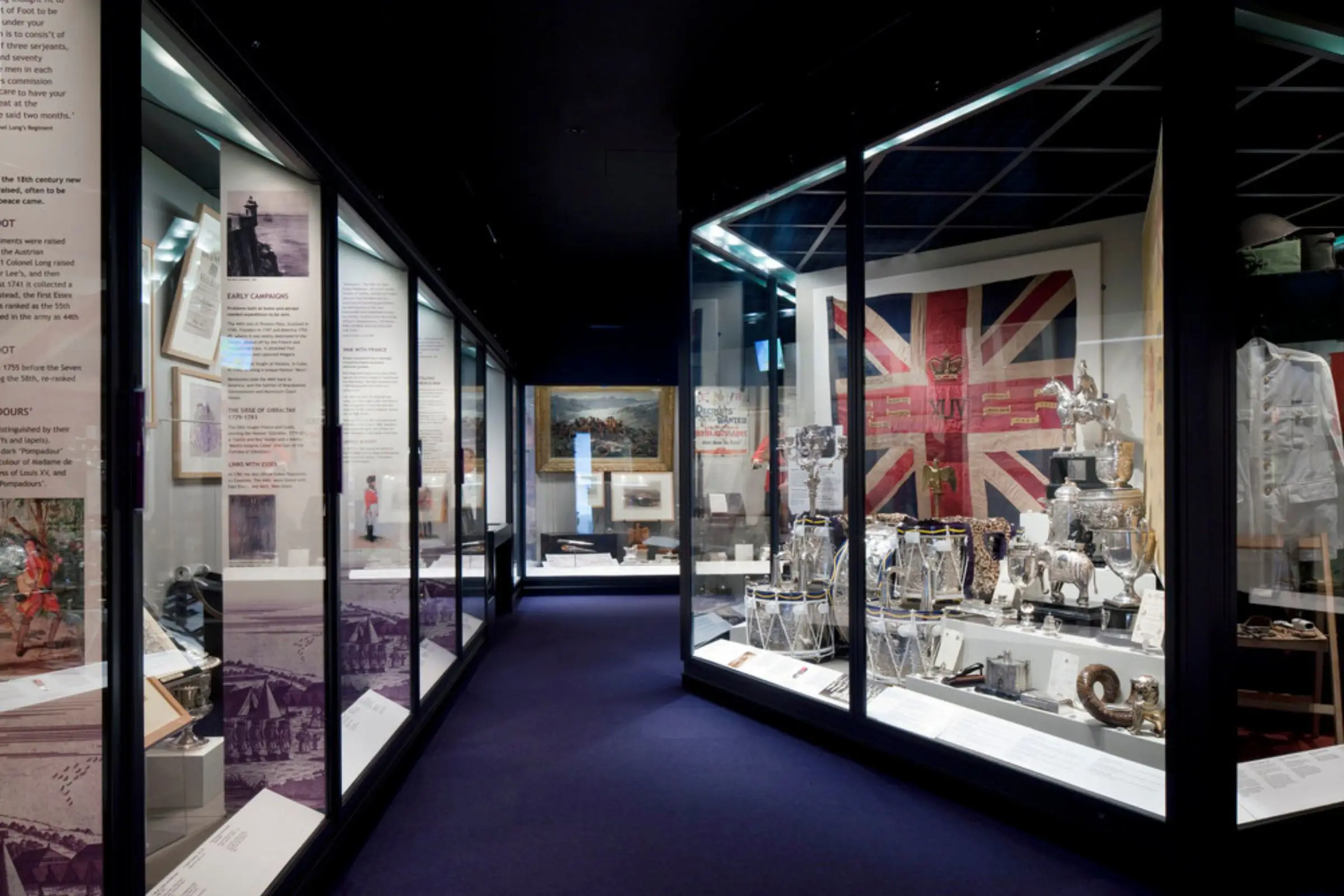
There are two exciting new permanent displays at the Museum, showing the history of the Essex Regiment and the Essex Yeomanry.
Origins
The rise of England as a world power in the seventeenth and eighteenth centuries meant a gradual expansion of the standing army. In 1741 what was later to be known as the 44th Regiment of Foot was one of seven infantry regiments raised during the War of the Austrian Succession. A few years later - in 1755 - with the approach of what was to become known as The Seven Years War, ten additional foot regiments were raised. These included the 56th Regiment of Foot.
The Pompadours
This Regiment adopted for its facing colour (collar, lapels and cuffs), a shade known today as "Rose-Pompadour", the favourite colour of the Marquise de Pompadour, mistress of King Louis XIV. Their smart appearance soon earned the Corps its nickname of "The Pompadours" or "The Saucy Pompadours", a nickname which has lasted to modern times.
Early campaigns
Both Regiments saw action soon after formation. The 44th Foot was present at the Battle of Preston Pans in 1745, and again saw service in Flanders in 1747. In 1755 it was sent to North America, where it experienced the greatest hardships and suffered severe losses in the ten years' campaigning it was to experience before returning home in 1765. It shared in the tragic march of Braddock's ill-fated column through the American forests, and in the disastrous attack on Fort Ticonderoga and the capture of Niagara, where the French were completely defeated.
The 56th first saw service at the capture of Havana, in Cuba, in 1762. For the gallant part it played in the capture of Fort Moro, the main defence of the city, the Regiment was awarded the unique battle honour "Moro", in addition to the honour "Havannah" given to all regiments in the expedition. These are the oldest battle honours emblazoned on the Colours of The Essex Regiment.
The outbreak of the War of American Independence sent the 44th once more to North America. Landing in 1775, it fought with commendable courage through that unfortunate campaign, taking part in the battles of Brandywine, Germanstown and Monmouth Court House. In 1780 it was transferred to Canada, staying there until sent home in 1786.
Meanwhile the 56th Foot, on return from Havana, had enjoyed a short spell of garrison duty in Ireland before being sent in 1770 to Gibraltar, where it was to serve for over twelve years. This tour of duty included service through the Great Siege of Gibraltar (1779-83) by the combined forces of France and Spain, who were allied with the American colonists against Britain. The Rock was held only by the indomitable courage of its garrison.
The Castle and Key Badge
The 56th Foot, together with the 12, 39 and 48th Regiments, was awarded the battle honour "Gibraltar, 1779-83", with the right to bear on its Colour a "Castle and Key" with the motto "Montis Insignia Calpe" (the sign of the Rock of Calpe - Calpe being the ancient name for Gibraltar).
The Key is symbolic of Gibraltar being the key to the Mediterranean. The "Castle and Key", continue to be part of the badge of the Royal Anglian Regiment.
Connection with Essex
In 1782 a system of linking regiments territorially with geographical areas took place. The 44th became the 44th or East Essex Regiment, and the 56th, the Pompadours, the West Essex Regiment. This was the first territorial connection of the two regiments with Essex.
Museums, Libraries and Archives Council - Registration Number 580
For Regimental Museums www.armymuseums.org.uk
Army Records- for soldiers who served after 1920
Army Personnel Centre Secretariat
Disclosures 2 Mail Point 515
Kentigern House 65 Brown Street
Glasgow
G2 8EX
Tel: 0845 600 9663 (helpline)
E-mail: disc4@apc.army.mod.uk
Medals
MOD Medal Office
Innsworth House Imjin Barracks
Glos.
GL3 1HW
Tel: 0141 224 3600
E-mail: JPAC@spva.mod.uk